
Property fund return of 6 to 7%: what is realistic?
A property fund lets you share in the benefits of property without buying, letting or managing a property yourself. The most important question for most investors is simple: what does it yield? On this page you can read how the return of a property fund is built up, what is realistic in the current market, and what return Zeker Wonen Fonds III offers.
- Fixed interest, paid monthly
- First-ranking mortgage
- No entry or exit costs
How your return is built up
The return of a property fund comes from two sources. Together they determine what you are left with at the bottom line.

Direct return
The income from rent. This is the part that is paid out to investors monthly and provides a predictable cash flow. The monthly rental income forms the basis for the interest payment that you automatically receive in your account every month.
Indirect return
The increase in the value of the property. Properties can gain value through renovation, better lettability or market developments. This part is less predictable than the rental income and often only materialises at the end of the term. Depending on the fund or the transaction, a profit share may also apply, for example on the sale or refinancing of the property.
Value growth
Historically, property has shown an average annual increase in value of around 4 to 5%, measured over recent decades. We usually work with a fund term of five years. For the Bridge Fonds, a term of 6 to 18 months per transaction applies instead. The increase in value of a property consists of two components: the annual market development and the revaluation that results from our sustainable renovations. At the end of the term, the market value is determined by an independent valuer. Depending on the fund, the realised profit is paid out to the bondholders.
- House prices
- Market rents
- Inflation
Index of purchase and rental prices in the Netherlands, per quarter from 2014 to 2022.
Every first week of the month
When and how do you receive your return?
Every first week of the month you receive your return by bank transfer. The payment is proportional to the number of bonds you hold. No waiting for the quarter, no uncertainty about timing.
What return on a property fund is realistic?
The return of a property fund usually fluctuates between 3% and 8% per year. Where a fund falls within that range depends on the type of property, the financing and the way the fund is set up. Broadly speaking, there are three forms, each with its own return profile.
Direct property funds
Buy and manage physical properties, such as homes or shops. The gross return is often around 5 to 6%. After costs, a net return of around 3 to 4% remains.
3 to 4% netProperty bonds
These work differently. You lend money to a property party in exchange for a fixed interest rate, usually between 5 and 8.5%, depending on the risk and your participation amount. The interest is fixed in advance, which makes the return predictable.
5 to 8.5% fixedProperty ETFs and shares (REITs)
You buy these yourself via the stock exchange. They are cheap to manage and easy to trade, but move with the stock market and are therefore subject to price fluctuations.
Moves with the marketImportant to know: past returns offer no guarantee for the future. Factors such as vacancy, interest rate developments and maintenance costs have a direct impact on what a fund ultimately yields. A higher quoted return almost always goes hand in hand with a higher risk.
The returns of Zeker Wonen Fondsen
At Zeker Wonen Fondsen we deliberately choose a simple, transparent structure without surprises. You see exactly in advance which return applies to which participation amount, what the term is and when you receive your interest. No unclear terms, but a fixed interest rate paid into your account every month, supplemented with a profit share for some funds.
Fonds III - A
per year
- Entry from €5,000
- 5-year term
- Monthly interest
- First-ranking mortgage
Fonds III - A
per year
- Entry from €25,000
- 5-year term
- Monthly interest
- First-ranking mortgage
Fonds III - B
per year
- Entry from €100,000
- 5-year term
- Monthly interest
- First-ranking mortgage
Bridge Fonds
per year
- Entry from €100,000
- 6 to 18-month term
- Monthly interest
- Profit share per transaction
Compare the funds
| Fonds III - A (€5,000) | Bridge Fonds | |
|---|---|---|
| Return per year | 6% | 6.5% |
| Entry from | €5,000 | €100,000 |
| Increase per | €1,000 | €25,000 |
| Term | 5 years | 6 to 18 months |
| Interest payout | Monthly | Monthly |
| Security | Yes | Per transaction |
| Profit share | – | Per transaction |
| Status | Open for subscription | Coming soon |
| Fonds III - A (€5,000) | Fonds III - A (€25,000) | Fonds III - B (€100,000) | Bridge Fonds | Fonds II (closed) | |
|---|---|---|---|---|---|
| Return per year | 6% | 6.5% | 7% | 6.5% | 5.5% |
| Entry from | €5,000 | €25,000 | €100,000 | €100,000 | €5,000 |
| Increase per | €1,000 | €1,000 | €25,000 | €25,000 | €1,000 |
| Term | 5 years | 5 years | 5 years | 6 to 18 months | 5 years |
| Interest payout | Monthly | Monthly | Monthly | Monthly | Monthly |
| Security | Yes | Yes | Yes | Per transaction | – |
| Profit share | – | – | – | Per transaction | Yes |
| Status | Open for subscription | Open for subscription | Open for subscription | Coming soon | Closed |
The interest is contractually fixed for the term. Calculation examples exclude any costs and taxes. Investing involves risks, read the risks.
What your participation earns
Worked example Fonds III - A6% per year
Monthly interest
Annual interest
Total over 5 years
Indicative. Your interest is paid out every first week of the month.
Request the brochureHow the return of Fonds III is built up
The return within Fonds III rests on three pillars.
Rental income
The properties the fund buys generate monthly rental income. This rental stream forms the basis for the interest payments to investors.
Renovation and splitting
By renovating properties, making them more sustainable and splitting them where possible, lettability and often value increase. Think of maintenance, modernisation, better energy labels and extra homes within the same building.
Purchase below market value
Property in a let condition can often be bought at a sharper price. This immediately creates room between the purchase price and the market value, which contributes to the stability of the fund.
Returns with security as the basis
A higher return says little without the security beneath it. With Fonds III, the most important of these is the first-ranking mortgage, which is established on every property in favour of the Stichting Obligatiehouders Wonen Fondsen.
This means that the foundation, on behalf of all investors, is the first mortgagee on the underlying property. In a forced sale, investors are paid first from the proceeds through the foundation, with tangible collateral in the form of real estate.
Read more about securityFirst-ranking mortgage
Established on every property in favour of the Stichting Obligatiehouders Wonen Fondsen. In a forced sale, investors are paid first from the proceeds through the foundation.
Independent foundation
The foundation operates fully independently of Zeker Wonen Fondsen B.V. and oversees compliance with your rights as a bondholder.
No entry or exit costs
You pay no entry, exit or issuance costs on top of your participation amount, and you receive interest on the full amount. Of every euro invested, €0.92 goes directly into the property. The remaining €0.08 covers the costs of the fund.
What are the risks?
Being honest about risks is part of our no-nonsense approach. Historically, investing in property is one of the most stable forms of investing, but risks can never be ruled out entirely. The main ones at a glance:
We do everything we can to limit these risks through thorough research, careful selection and fully in-house management. But complete certainty does not exist in investing. We think it is important that you, as an investor, are well aware of this.
All about the risksMarket risk
The value of property can fluctuate due to economic conditions, interest rate developments and shifts in supply and demand.
Letting risk
Properties can be temporarily vacant or tenants may fail to meet their payment obligations. We minimise this risk through active management by our own team.
Interest rate risk
Interest rate fluctuations can affect financing costs and therefore the return.
Regulatory risk
Changes in laws and regulations around taxes or rental rules can affect the property market.
Maintenance risk
Unforeseen costs for maintenance or renovation can increase operating costs. Because we carry out everything in-house, we keep maximum control over this.
Return and tax (box 3)
If you invest as a private individual, your investment in the Netherlands falls under box 3. In 2026 the Dutch tax authority applies a notional return in box 3 on the value of your assets, on which you pay tax. From 2028 the government intends to switch to taxation based on actual returns, with rental income taxed annually and capital gains only on sale. If you invest through a company, corporate income tax applies.
Whether this works out favourably or unfavourably for you depends entirely on your personal situation and the way you invest.
We do not give tax advice. Always seek advice on this from a financial adviser or accountant.
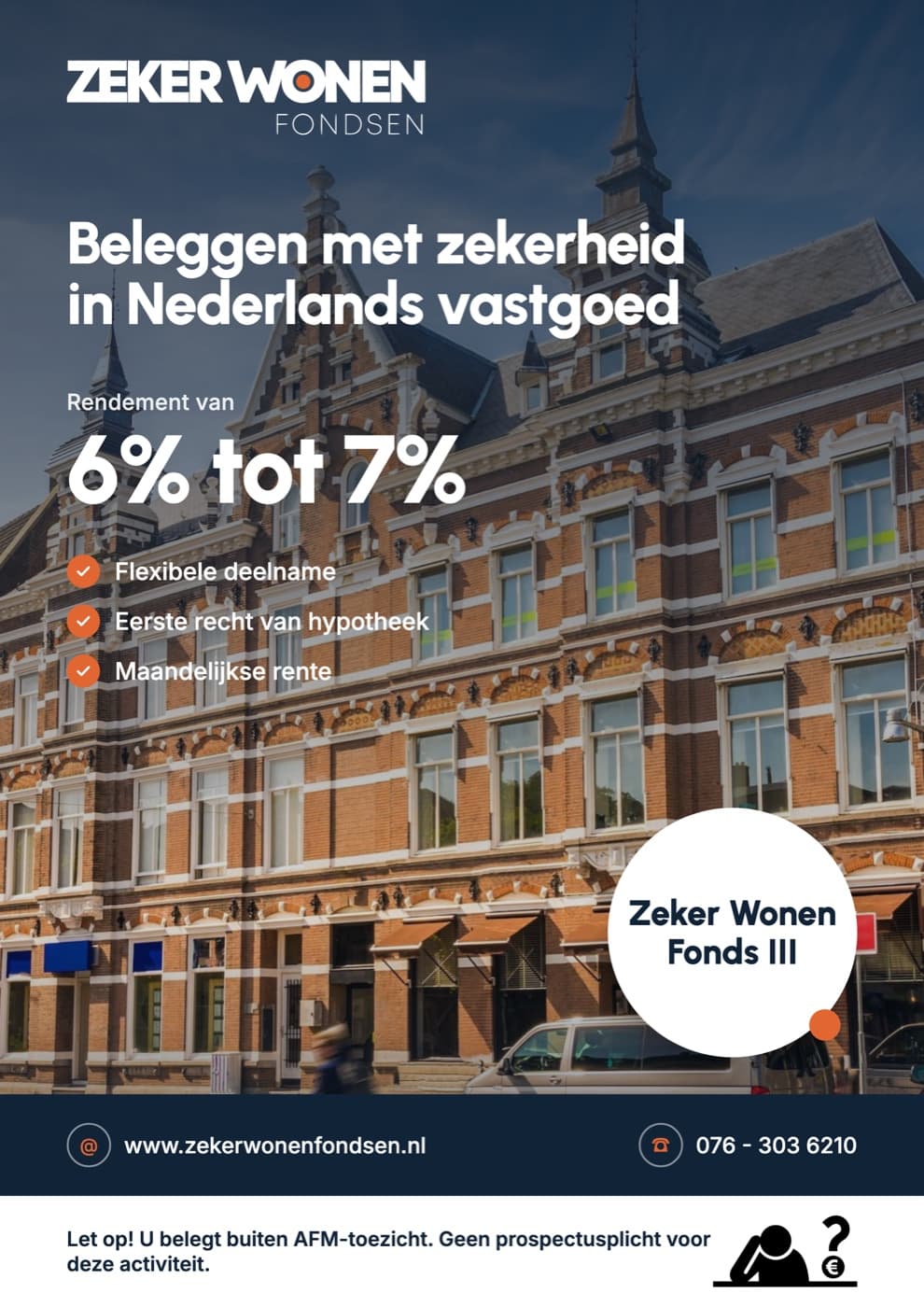
Want to know more? Get the brochure
After your request, we will contact you personally to verify your details and answer your questions. You will then receive the brochure.
Common questions about property fund returns
Investing raises questions. Naturally, it is your money after all. That is why we have listed the most frequently asked questions, so you know exactly where you stand.
Ask a questionThat depends on the type and the risk. Property funds that invest directly in property often come out at around 3% to 4% net per year after costs. Property bonds usually offer an interest rate agreed in advance, often between 5% and 8.5%. A higher return almost always goes hand in hand with a higher risk. So look not only at the percentage, but also at the security beneath it, such as a first-ranking mortgage.
Direct return is the income from rent, which is paid out periodically. Indirect return is the increase in the property's value, which often only becomes visible over the longer term. Direct return is more predictable; indirect return depends on the market.
No, there is no guarantee. What is the case for our current funds (Fonds III and the Bridge Fonds) is that the interest is contractually fixed in the bond terms for the full term. In addition, there is security behind your investment, such as a first-ranking mortgage with Fonds III. Investing always involves risks. Please also read our risks.
You can participate from €5,000 with Fonds III, or from €100,000 with the Bridge Fonds. With Fonds III you receive 6% interest per year and can increase your participation amount in steps of €1,000. From €25,000 an interest rate of 6.5% applies, and from €100,000 you receive 7% per year.
No, you pay no entry, exit or issuance costs on top of your participation amount. You receive interest on the full amount. Of every euro invested, €0.92 goes directly into the property; the remaining €0.08 covers the costs of the fund.
Yes. The payment is based on the total fund structure, not on one individual property. Because we manage several properties per fund, the vacancy risk is spread across the entire portfolio.